Showing posts with label greentailing. Show all posts

The price barrier to sustainable shopping

Financial constraints are restricting ‘green and ethical living’, according to the British-based division of market researchers Mintel.

Indeed, one in five consumers are not in a financial position to think about green or ethical issues. Even before the recession, price premiums were a barrier to more widespread take-up of green and ethical products and the evidence of altered priorities is that 12% of adults stated that they could no longer afford price premiums for green or ethical products.

However, the new report also shows a strong commitment to ethical and environmental issues, as those rating them as ‘very important’ were actually up marginally on 2008. Today, some 97% of adults have adopted at least one of the greener behaviours included in the survey, implying that there is a strong basis of support for further green initiatives, such as energy-saving ideas, if retailers and manufacturers were to provide positive leadership.

Indeed, in terms of low cost greener actions such as using re-usable bags and switching to low energy light bulbs behaviour has been unaffected by the recession.

Australian research released this year by IBISWorld has highlighted the cost of shopping with a conscience, while a study by Unilever showed that 51% of Australians were more concerned by sustainability this year than last.
Click here to read further.

Source: http://www.ausfoodnews.com.au/2009/10/15/the-price-barrier-to-sustainable-shopping.html

100% ECO Hygienic Paper available at the supermarkets of Albert Heijn and Coop (The Netherlands)

Since today the Dutch consumers are able to purchase 100% ECO Hygienic Paper. The first supermarkets in The Netherlands who offer this environmental-friendly product are Albert Heijn and Coop. The assortment these stores offer are toilet paper, kitchen rolls and tissues of the brand NORTH RIVER. The products are the most environmental friendly products of the market. By using the product the Dutch consumers help to improve the environment.

The production of these paper product is realized by recycled wood, there is no chlorine included, 80% less water is used and the production process is realized by 100% sustainable energy.
For more information on these products take a look at the website of Friends Hygiene or contact them by e-mail jan@friendshygiene.nl

De Groene Weg: the greenest store of the Netherlands 2009

Themagazine ‘Green.2’ published in its most recent magazine a list of the 200 greenest companies of The Netherlands: The Green 200. The butchers of The Groene Weg, specialists of biological meat / food products are the winner in the Categry Foodies.

Jos de Vries The Retail Company, responsable for the succesfull renovation of the store concept, congratulates De Groene Weg with the award on their green retailing policy.


http://www.josdevries.eu/engels/04_a_food/speciality/html/spec_groene_02.html

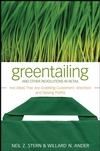
An introduction to greentailing and the five other biggest trends in the retail business

Read for you: Literature in greentailing, success factors for green retailers.
Cover image for product 0470288582
Greentailing and Other Revolutions in Retail: Hot Ideas That Are Grabbing Customers' Attention and Raising Profits
ISBN: 978-0-470-28858-0
Hardcover
272 pages
October 2008
£19.99 / €25.00 Add to Cart

An introduction to greentailing and the five other biggest trends in the retail business

In their newest book on retailing, authors Stern and Ander examine the revolutions occurring in the retail marketplace, with particular emphasis on the influential green trend in retailing, or Greentailing. Greentailing is capitalizing on the huge and growing demand for organic, sustainable and wellness-related products. As it evolves, greentailing will force both suppliers and retailers alike in every category to take notice. Leading edge greentailers like Whole Foods and Wal*Mart continue to grow and innovate at rates much faster than traditional competitors, and are forcing competitive responses. The authors explain how any retail store or manufacturer can implement these ideas and raise profits, using case studies from successful greentailers.

In addition to greentailing, the book examines five other top retail trends:

  • Demographic Shifts Provide Retail Opportunities
  • Moving Up the Ladder—Growth of Experiential Retailing—How to Drive Sales and Profits Beyond Price
  • Getting Outside the Box—New Ways to Reach the Consumer—The Growth of Non-Store Retailing
  • Selling Services, Not Just products
  • Brands Going Retail—The Battle for Control of the Customer

Very much a follow up to their first book, Winning at Retail: Developing a Sustained Model for Retail Success, Greentailing and Other Revolutions in Retail addresses all the latest trends in the retail industry and presents unbeatable advice on quickly responding to changes in customer demographics and competition. Retail is all about the customer, and as customers and their tastes change, this one-of-a-kind resource shows retailers and manufacturers how to keep up and innovate.

Consumers pay more attention to the environment at the moment they shop

A research of the European Union, published yesterday, shows that 4 out of 5 European consumers look at the effects on the environment of the products they purchase.

The attention for the environment is the highest in Greece, over 90 per cent of the inhabitants of this country mention that the effects on the environments play an important role at their purchases. The lowest score has Czech Republic, where 62 per cent of the population pays attation to the environmental impact.

More than 50 per cent of the EU consumers trust the information that manufacturers give about the performances and effect of the their products. The highest score get the consumers of The Netherlands (78 per cent), the lowest trust can be seen in Bulgaria (26 per cent).

The research states that 46 per cent of the European consumers supports the increase of taxes on products that are harmfull for the environment and decrease the taxes on green products.

The consumers have the wish that retailers better present and promote the green products and that information on the carbon footprint is given, to see the effect of the purchase of a certain product on the environment.
Blog Widget by LinkWithin